---
title: "JSX"
description: "Built-in JSX and TSX support in Bun with configurable transpilation options"
---
Bun supports `.jsx` and `.tsx` files out of the box. Bun's internal transpiler converts JSX syntax into vanilla JavaScript before execution.
```ts react.tsx icon="/icons/typescript.svg"
function Component(props: {message: string}) {
return (
{props.message}
);
}
console.log();
```
## Configuration
Bun reads your `tsconfig.json` or `jsconfig.json` configuration files to determines how to perform the JSX transform internally. To avoid using either of these, the following options can also be defined in [`bunfig.toml`](/runtime/bunfig).
The following compiler options are respected.
### [`jsx`](https://www.typescriptlang.org/tsconfig#jsx)
How JSX constructs are transformed into vanilla JavaScript internally. The table below lists the possible values of `jsx`, along with their transpilation of the following simple JSX component:
```tsx
Hello
```
| Compiler options | Transpiled output |
| --------------------------------------------------- | ------------------------------------------------------------------------------------------------------------------------------------------------------------------------------------------------------------------------------------------------------------------------------------------------------------------------------------------------------------------------------------------------------------------------------------------------------------------------- |
| `json
{
"jsx": "react"
}
` | `tsx
import { createElement } from "react";
createElement("Box", { width: 5 }, "Hello");
` |
| `json
{
"jsx": "react-jsx"
}
` | `tsx
import { jsx } from "react/jsx-runtime";
jsx("Box", { width: 5 }, "Hello");
` |
| `json
{
"jsx": "react-jsxdev"
}
` | `tsx
import { jsxDEV } from "react/jsx-dev-runtime";
jsxDEV(
"Box",
{ width: 5, children: "Hello" },
undefined,
false,
undefined,
this,
);
`
The `jsxDEV` variable name is a convention used by React. The `DEV` suffix is a visible way to indicate that the code is intended for use in development. The development version of React is slower and includes additional validity checks & debugging tools. |
| `json
{
"jsx": "preserve"
}
` | `tsx
// JSX is not transpiled
// "preserve" is not supported by Bun currently
Hello
` |
### [`jsxFactory`](https://www.typescriptlang.org/tsconfig#jsxFactory)
**Note** — Only applicable when `jsx` is `react`.
The function name used to represent JSX constructs. Default value is `"createElement"`. This is useful for libraries like [Preact](https://preactjs.com/) that use a different function name (`"h"`).
| Compiler options | Transpiled output |
| --------------------------------------------------------------------- | ------------------------------------------------------------------------------ |
| `json
{
"jsx": "react",
"jsxFactory": "h"
}
` | `tsx
import { h } from "react";
h("Box", { width: 5 }, "Hello");
` |
### [`jsxFragmentFactory`](https://www.typescriptlang.org/tsconfig#jsxFragmentFactory)
**Note** — Only applicable when `jsx` is `react`.
The function name used to represent [JSX fragments](https://react.dev/reference/react/Fragment) such as `<>Hello`; only applicable when `jsx` is `react`. Default value is `"Fragment"`.
| Compiler options | Transpiled output |
| ------------------------------------------------------------------------------------------------------------------- | ----------------------------------------------------------------------------------------------------------------------------------------------- |
| `json
{
"jsx": "react",
"jsxFactory": "myjsx",
"jsxFragmentFactory": "MyFragment"
}
` | `tsx
// input
<>Hello;
// output
import { myjsx, MyFragment } from "react";
myjsx(MyFragment, null, "Hello");
` |
### [`jsxImportSource`](https://www.typescriptlang.org/tsconfig#jsxImportSource)
**Note** — Only applicable when `jsx` is `react-jsx` or `react-jsxdev`.
The module from which the component factory function (`createElement`, `jsx`, `jsxDEV`, etc) will be imported. Default value is `"react"`. This will typically be necessary when using a component library like Preact.
| Compiler options | Transpiled output |
| ------------------------------------------------------------------------------------------------------------------ | ----------------------------------------------------------------------------------------------------------------------------------------------------------------------------------------------------------------------------------------------- |
| `jsonc
{
"jsx": "react",
// jsxImportSource is not defined
// default to "react"
}
` | `tsx
import { jsx } from "react/jsx-runtime";
jsx("Box", { width: 5, children: "Hello" });
` |
| `jsonc
{
"jsx": "react-jsx",
"jsxImportSource": "preact",
}
` | `tsx
import { jsx } from "preact/jsx-runtime";
jsx("Box", { width: 5, children: "Hello" });
` |
| `jsonc
{
"jsx": "react-jsxdev",
"jsxImportSource": "preact",
}
` | `tsx
// /jsx-runtime is automatically appended
import { jsxDEV } from "preact/jsx-dev-runtime";
jsxDEV(
"Box",
{ width: 5, children: "Hello" },
undefined,
false,
undefined,
this,
);
` |
### JSX pragma
All of these values can be set on a per-file basis using _pragmas_. A pragma is a special comment that sets a compiler option in a particular file.
| Pragma | Equivalent config |
| ---------------------------------------- | ------------------------------------------------------------------ |
| `ts
// @jsx h
` | `jsonc
{
"jsxFactory": "h",
}
` |
| `ts
// @jsxFrag MyFragment
` | `jsonc
{
"jsxFragmentFactory": "MyFragment",
}
` |
| `ts
// @jsxImportSource preact
` | `jsonc
{
"jsxImportSource": "preact",
}
` |
## Logging
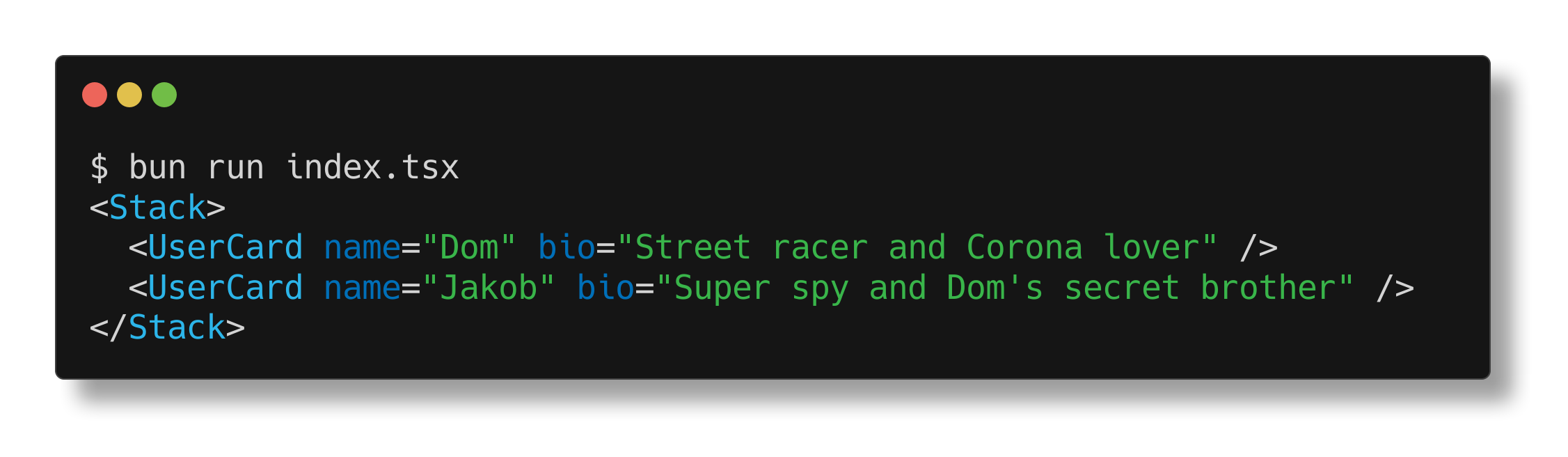
Bun implements special logging for JSX to make debugging easier. Given the following file:
```tsx index.tsx icon="/icons/typescript.svg"
import { Stack, UserCard } from "./components";
console.log(
,
);
```
Bun will pretty-print the component tree when logged:
## Prop punning
The Bun runtime also supports "prop punning" for JSX. This is a shorthand syntax useful for assigning a variable to a prop with the same name.
```tsx react.tsx icon="/icons/typescript.svg"
function Div(props: {className: string;}) {
const {className} = props;
// without punning
return ;
// with punning
return ;
}
```