---
title: "bun install"
description: "Install packages with Bun's fast package manager"
---
import Install from "/snippets/cli/install.mdx";
## Basic Usage
```bash terminal icon="terminal"
bun install react
bun install react@19.1.1 # specific version
bun install react@latest # specific tag
```
The `bun` CLI contains a Node.js-compatible package manager designed to be a dramatically faster replacement for `npm`, `yarn`, and `pnpm`. It's a standalone tool that will work in pre-existing Node.js projects; if your project has a `package.json`, `bun install` can help you speed up your workflow.
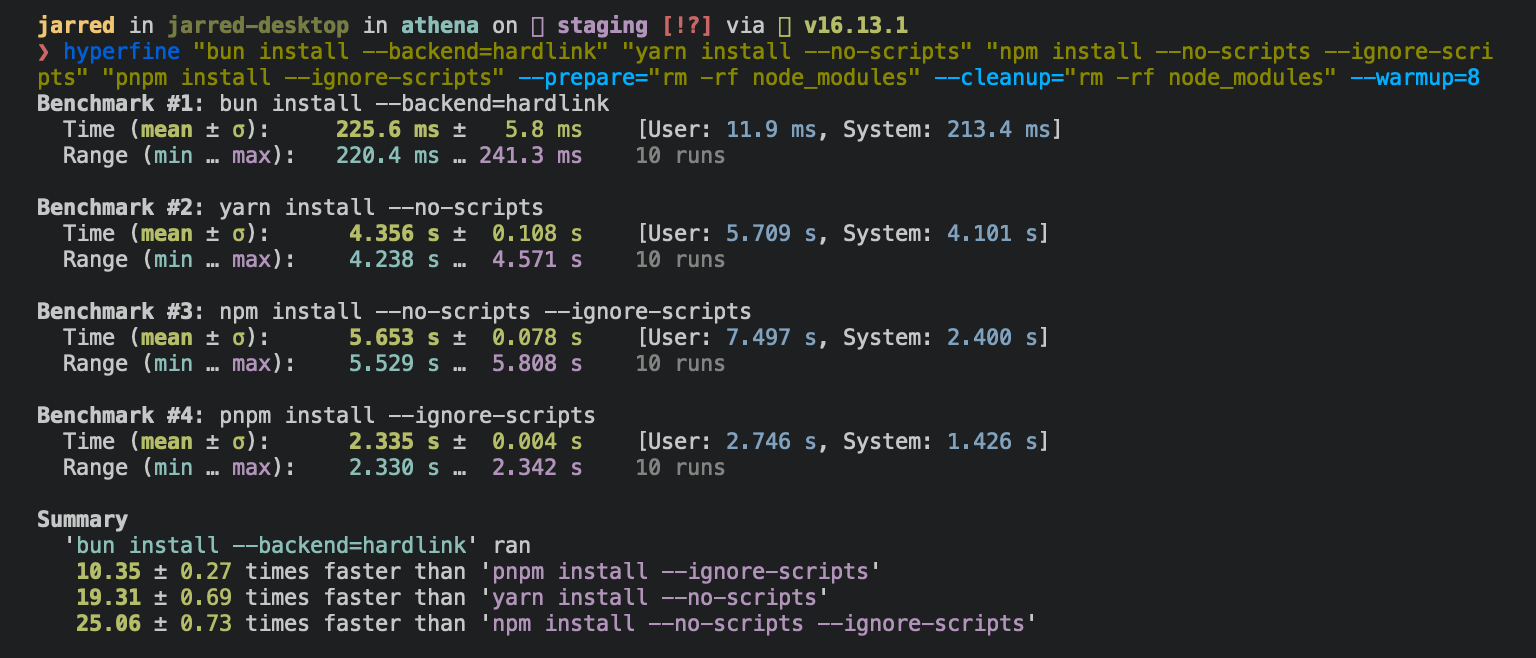
**⚡️ 25x faster** — Switch from `npm install` to `bun install` in any Node.js project to make your installations up to 25x faster.
The recommended minimum Linux Kernel version is 5.6. If you're on Linux kernel 5.1 - 5.5, `bun install` will work, but HTTP requests will be slow due to a lack of support for io_uring's `connect()` operation.
If you're using Ubuntu 20.04, here's how to install a [newer kernel](https://wiki.ubuntu.com/Kernel/LTSEnablementStack):
```bash terminal icon="terminal"
# If this returns a version >= 5.6, you don't need to do anything
uname -r
# Install the official Ubuntu hardware enablement kernel
sudo apt install --install-recommends linux-generic-hwe-20.04
```
To install all dependencies of a project:
```bash terminal icon="terminal"
bun install
```
Running `bun install` will:
- **Install** all `dependencies`, `devDependencies`, and `optionalDependencies`. Bun will install `peerDependencies` by default.
- **Run** your project's `{pre|post}install` and `{pre|post}prepare` scripts at the appropriate time. For security reasons Bun _does not execute_ lifecycle scripts of installed dependencies.
- **Write** a `bun.lock` lockfile to the project root.
---
## Logging
To modify logging verbosity:
```bash terminal icon="terminal"
bun install --verbose # debug logging
bun install --silent # no logging
```
---
## Lifecycle scripts
Unlike other npm clients, Bun does not execute arbitrary lifecycle scripts like `postinstall` for installed dependencies. Executing arbitrary scripts represents a potential security risk.
To tell Bun to allow lifecycle scripts for a particular package, add the package to `trustedDependencies` in your package.json.
```json package.json icon="file-json"
{
"name": "my-app",
"version": "1.0.0",
"trustedDependencies": ["my-trusted-package"] // [!code ++]
}
```
Then re-install the package. Bun will read this field and run lifecycle scripts for `my-trusted-package`.
Lifecycle scripts will run in parallel during installation. To adjust the maximum number of concurrent scripts, use the `--concurrent-scripts` flag. The default is two times the reported cpu count or GOMAXPROCS.
```bash terminal icon="terminal"
bun install --concurrent-scripts 5
```
---
## Workspaces
Bun supports `"workspaces"` in package.json. For complete documentation refer to [Package manager > Workspaces](/pm/workspaces).
```json package.json icon="file-json"
{
"name": "my-app",
"version": "1.0.0",
"workspaces": ["packages/*"], // [!code ++]
"dependencies": {
"preact": "^10.5.13"
}
}
```
---
## Installing dependencies for specific packages
In a monorepo, you can install the dependencies for a subset of packages using the `--filter` flag.
```bash terminal icon="terminal"
# Install dependencies for all workspaces except `pkg-c`
bun install --filter '!pkg-c'
# Install dependencies for only `pkg-a` in `./packages/pkg-a`
bun install --filter './packages/pkg-a'
```
For more information on filtering with `bun install`, refer to [Package Manager > Filtering](/pm/filter#bun-install-and-bun-outdated)
---
## Overrides and resolutions
Bun supports npm's `"overrides"` and Yarn's `"resolutions"` in `package.json`. These are mechanisms for specifying a version range for _metadependencies_—the dependencies of your dependencies. Refer to [Package manager > Overrides and resolutions](/pm/overrides) for complete documentation.
```json package.json file="file-json"
{
"name": "my-app",
"dependencies": {
"foo": "^2.0.0"
},
"overrides": {
// [!code ++]
"bar": "~4.4.0" // [!code ++]
} // [!code ++]
}
```
---
## Global packages
To install a package globally, use the `-g`/`--global` flag. Typically this is used for installing command-line tools.
```bash terminal icon="terminal"
bun install --global cowsay # or `bun install -g cowsay`
cowsay "Bun!"
```
```txt
______
< Bun! >
------
\ ^__^
\ (oo)\_______
(__)\ )\/\
||----w |
|| ||
```
---
## Production mode
To install in production mode (i.e. without `devDependencies` or `optionalDependencies`):
```bash terminal icon="terminal"
bun install --production
```
For reproducible installs, use `--frozen-lockfile`. This will install the exact versions of each package specified in the lockfile. If your `package.json` disagrees with `bun.lock`, Bun will exit with an error. The lockfile will not be updated.
```bash terminal icon="terminal"
bun install --frozen-lockfile
```
For more information on Bun's lockfile `bun.lock`, refer to [Package manager > Lockfile](/pm/lockfile).
---
## Omitting dependencies
To omit dev, peer, or optional dependencies use the `--omit` flag.
```bash terminal icon="terminal"
# Exclude "devDependencies" from the installation. This will apply to the
# root package and workspaces if they exist. Transitive dependencies will
# not have "devDependencies".
bun install --omit dev
# Install only dependencies from "dependencies"
bun install --omit=dev --omit=peer --omit=optional
```
---
## Dry run
To perform a dry run (i.e. don't actually install anything):
```bash terminal icon="terminal"
bun install --dry-run
```
---
## Non-npm dependencies
Bun supports installing dependencies from Git, GitHub, and local or remotely-hosted tarballs. For complete documentation refer to [Package manager > Git, GitHub, and tarball dependencies](/pm/cli/add).
```json package.json icon="file-json"
{
"dependencies": {
"dayjs": "git+https://github.com/iamkun/dayjs.git",
"lodash": "git+ssh://github.com/lodash/lodash.git#4.17.21",
"moment": "git@github.com:moment/moment.git",
"zod": "github:colinhacks/zod",
"react": "https://registry.npmjs.org/react/-/react-18.2.0.tgz",
"bun-types": "npm:@types/bun"
}
}
```
---
## Installation strategies
Bun supports two package installation strategies that determine how dependencies are organized in `node_modules`:
### Hoisted installs (default for single projects)
The traditional npm/Yarn approach that flattens dependencies into a shared `node_modules` directory:
```bash terminal icon="terminal"
bun install --linker hoisted
```
### Isolated installs
A pnpm-like approach that creates strict dependency isolation to prevent phantom dependencies:
```bash terminal icon="terminal"
bun install --linker isolated
```
Isolated installs create a central package store in `node_modules/.bun/` with symlinks in the top-level `node_modules`. This ensures packages can only access their declared dependencies.
For complete documentation on isolated installs, refer to [Package manager > Isolated installs](/pm/isolated-installs).
---
## Minimum release age
To protect against supply chain attacks where malicious packages are quickly published, you can configure a minimum age requirement for npm packages. Package versions published more recently than the specified threshold (in seconds) will be filtered out during installation.
```bash terminal icon="terminal"
# Only install package versions published at least 3 days ago
bun add @types/bun --minimum-release-age 259200 # seconds
```
You can also configure this in `bunfig.toml`:
```toml bunfig.toml icon="settings"
[install]
# Only install package versions published at least 3 days ago
minimumReleaseAge = 259200 # seconds
# Exclude trusted packages from the age gate
minimumReleaseAgeExcludes = ["@types/node", "typescript"]
```
When the minimum age filter is active:
- Only affects new package resolution - existing packages in `bun.lock` remain unchanged
- All dependencies (direct and transitive) are filtered to meet the age requirement when being resolved
- When versions are blocked by the age gate, a stability check detects rapid bugfix patterns
- If multiple versions were published close together just outside your age gate, it extends the filter to skip those potentially unstable versions and selects an older, more mature version
- Searches up to 7 days after the age gate, however if still finding rapid releases it ignores stability check
- Exact version requests (like `package@1.1.1`) still respect the age gate but bypass the stability check
- Versions without a `time` field are treated as passing the age check (npm registry should always provide timestamps)
For more advanced security scanning, including integration with services & custom filtering, see [Package manager > Security Scanner API](/pm/security-scanner-api).
---
## Configuration
The default behavior of `bun install` can be configured in `bunfig.toml`. The default values are shown below.
```toml bunfig.toml icon="settings"
[install]
# whether to install optionalDependencies
optional = true
# whether to install devDependencies
dev = true
# whether to install peerDependencies
peer = true
# equivalent to `--production` flag
production = false
# equivalent to `--save-text-lockfile` flag
saveTextLockfile = false
# equivalent to `--frozen-lockfile` flag
frozenLockfile = false
# equivalent to `--dry-run` flag
dryRun = false
# equivalent to `--concurrent-scripts` flag
concurrentScripts = 16 # (cpu count or GOMAXPROCS) x2
# installation strategy: "hoisted" or "isolated"
# default: "hoisted" (for single-project projects)
# default: "isolated" (for monorepo projects)
linker = "hoisted"
# minimum age config
minimumReleaseAge = 259200 # seconds
minimumReleaseAgeExcludes = ["@types/node", "typescript"]
```
---
## CI/CD
Use the official [`oven-sh/setup-bun`](https://github.com/oven-sh/setup-bun) action to install `bun` in a GitHub Actions pipeline:
```yaml .github/workflows/release.yml icon="file-code"
name: bun-types
jobs:
build:
name: build-app
runs-on: ubuntu-latest
steps:
- name: Checkout repo
uses: actions/checkout@v4
- name: Install bun
uses: oven-sh/setup-bun@v2
- name: Install dependencies
run: bun install
- name: Build app
run: bun run build
```
For CI/CD environments that want to enforce reproducible builds, use `bun ci` to fail the build if the package.json is out of sync with the lockfile:
```bash terminal icon="terminal"
bun ci
```
This is equivalent to `bun install --frozen-lockfile`. It installs exact versions from `bun.lock` and fails if `package.json` doesn't match the lockfile. To use `bun ci` or `bun install --frozen-lockfile`, you must commit `bun.lock` to version control.
And instead of running `bun install`, run `bun ci`.
```yaml .github/workflows/release.yml icon="file-code"
name: bun-types
jobs:
build:
name: build-app
runs-on: ubuntu-latest
steps:
- name: Checkout repo
uses: actions/checkout@v4
- name: Install bun
uses: oven-sh/setup-bun@v2
- name: Install dependencies
run: bun ci
- name: Build app
run: bun run build
```
## pnpm migration
Bun automatically migrates projects from pnpm to bun. When a `pnpm-lock.yaml` file is detected and no `bun.lock` file exists, Bun will automatically migrate the lockfile to `bun.lock` during installation. The original `pnpm-lock.yaml` file remains unmodified.
```bash terminal icon="terminal"
bun install
```
**Note**: Migration only runs when `bun.lock` is absent. There is currently no opt-out flag for pnpm migration.
The migration process handles:
### Lockfile Migration
- Converts `pnpm-lock.yaml` to `bun.lock` format
- Preserves package versions and resolution information
- Maintains dependency relationships and peer dependencies
- Handles patched dependencies with integrity hashes
### Workspace Configuration
When a `pnpm-workspace.yaml` file exists, Bun migrates workspace settings to your root `package.json`:
```yaml pnpm-workspace.yaml icon="file-code"
packages:
- "apps/*"
- "packages/*"
catalog:
react: ^18.0.0
typescript: ^5.0.0
catalogs:
build:
webpack: ^5.0.0
babel: ^7.0.0
```
The workspace packages list and catalogs are moved to the `workspaces` field in `package.json`:
```json package.json icon="file-json"
{
"workspaces": {
"packages": ["apps/*", "packages/*"],
"catalog": {
"react": "^18.0.0",
"typescript": "^5.0.0"
},
"catalogs": {
"build": {
"webpack": "^5.0.0",
"babel": "^7.0.0"
}
}
}
}
```
### Catalog Dependencies
Dependencies using pnpm's `catalog:` protocol are preserved:
```json package.json icon="file-json"
{
"dependencies": {
"react": "catalog:",
"webpack": "catalog:build"
}
}
```
### Configuration Migration
The following pnpm configuration is migrated from both `pnpm-lock.yaml` and `pnpm-workspace.yaml`:
- **Overrides**: Moved from `pnpm.overrides` to root-level `overrides` in `package.json`
- **Patched Dependencies**: Moved from `pnpm.patchedDependencies` to root-level `patchedDependencies` in `package.json`
- **Workspace Overrides**: Applied from `pnpm-workspace.yaml` to root `package.json`
### Requirements
- Requires pnpm lockfile version 7 or higher
- Workspace packages must have a `name` field in their `package.json`
- All catalog entries referenced by dependencies must exist in the catalogs definition
After migration, you can safely remove `pnpm-lock.yaml` and `pnpm-workspace.yaml` files.
---