 5424ea3403
* Remove v0.x messages

* Add windows section to Installatino

* update

* update

* Update

* Comment out windows
8.6 KiB
The page primarily documents the Bun-native Bun.serve API. Bun also implements fetch and the Node.js http and https modules.
{% callout %} These modules have been re-implemented to use Bun's fast internal HTTP infrastructure. Feel free to use these modules directly; frameworks like Express that depend on these modules should work out of the box. For granular compatibility information, see Runtime > Node.js APIs. {% /callout %}
To start a high-performance HTTP server with a clean API, the recommended approach is Bun.serve.
Bun.serve()
Start an HTTP server in Bun with Bun.serve.
Bun.serve({
  fetch(req) {
    return new Response(`Bun!`);
  },
});
The fetch handler handles incoming requests. It receives a Request object and returns a Response or Promise<Response>.
Bun.serve({
  fetch(req) {
    const url = new URL(req.url);
    if (url.pathname === "/") return new Response(`Home page!`);
    if (url.pathname === "/blog") return new Response("Blog!");
    return new Response(`404!`);
  },
});
To configure which port and hostname the server will listen on:
Bun.serve({
  port: 8080, // defaults to $BUN_PORT, $PORT, $NODE_PORT otherwise 3000
  hostname: "mydomain.com", // defaults to "0.0.0.0"
  fetch(req) {
    return new Response(`404!`);
  },
});
To listen on a unix domain socket:
Bun.serve({
  unix: "/tmp/my-socket.sock", // path to socket
  fetch(req) {
    return new Response(`404!`);
  },
});
Error handling
To activate development mode, set development: true. By default, development mode is enabled unless NODE_ENV is production.
Bun.serve({
  development: true,
  fetch(req) {
    throw new Error("woops!");
  },
});
In development mode, Bun will surface errors in-browser with a built-in error page.
{% image src="/images/exception_page.png" caption="Bun's built-in 500 page" /%}
To handle server-side errors, implement an error handler. This function should return a Response to served to the client when an error occurs. This response will supercede Bun's default error page in development mode.
Bun.serve({
  fetch(req) {
    throw new Error("woops!");
  },
  error(error) {
    return new Response(`<pre>${error}\n${error.stack}</pre>`, {
      headers: {
        "Content-Type": "text/html",
      },
    });
  },
});
{% callout %} Learn more about debugging in Bun {% /callout %}
The call to Bun.serve returns a Server object. To stop the server, call the .stop() method.
const server = Bun.serve({
  fetch() {
    return new Response("Bun!");
  },
});

server.stop();
TLS
Bun supports TLS out of the box, powered by BoringSSL. Enable TLS by passing in a value for key and cert; both are required to enable TLS.
  Bun.serve({
    fetch(req) {
      return new Response("Hello!!!");
    },

+   tls: {
+     key: Bun.file("./key.pem"),
+     cert: Bun.file("./cert.pem"),
+   }
  });
The key and cert fields expect the contents of your TLS key and certificate, not a path to it. This can be a string, BunFile, TypedArray, or Buffer.
Bun.serve({
  fetch() {},

  tls: {
    // BunFile
    key: Bun.file("./key.pem"),
    // Buffer
    key: fs.readFileSync("./key.pem"),
    // string
    key: fs.readFileSync("./key.pem", "utf8"),
    // array of above
    key: [Bun.file("./key1.pem"), Bun.file("./key2.pem")],
  },
});
If your private key is encrypted with a passphrase, provide a value for passphrase to decrypt it.
  Bun.serve({
    fetch(req) {
      return new Response("Hello!!!");
    },

    tls: {
      key: Bun.file("./key.pem"),
      cert: Bun.file("./cert.pem"),
+     passphrase: "my-secret-passphrase",
    }
  });
Optionally, you can override the trusted CA certificates by passing a value for ca. By default, the server will trust the list of well-known CAs curated by Mozilla. When ca is specified, the Mozilla list is overwritten.
  Bun.serve({
    fetch(req) {
      return new Response("Hello!!!");
    },
    tls: {
      key: Bun.file("./key.pem"), // path to TLS key
      cert: Bun.file("./cert.pem"), // path to TLS cert
+     ca: Bun.file("./ca.pem"), // path to root CA certificate
    }
  });
To override Diffie-Helman parameters:
Bun.serve({
  // ...
  tls: {
    // other config
    dhParamsFile: "/path/to/dhparams.pem", // path to Diffie Helman parameters
  },
});
Object syntax
Thus far, the examples on this page have used the explicit Bun.serve API. Bun also supports an alternate syntax.
import {type Serve} from "bun";

export default {
  fetch(req) {
    return new Response(`Bun!`);
  },
} satisfies Serve;
Instead of passing the server options into Bun.serve, export default it. This file can be executed as-is; when Bun sees a file with a default export containing a fetch handler, it passes it into Bun.serve under the hood.
Streaming files
To stream a file, return a Response object with a BunFile object as the body.
import { serve, file } from "bun";

serve({
  fetch(req) {
    return new Response(Bun.file("./hello.txt"));
  },
});
{% callout %}
⚡️ Speed — Bun automatically uses the sendfile(2) system call when possible, enabling zero-copy file transfers in the kernel—the fastest way to send files.
{% /callout %}
You can send part of a file using the slice(start, end) method on the Bun.file object. This automatically sets the Content-Range and Content-Length headers on the Response object.
Bun.serve({
  fetch(req) {
    // parse `Range` header
    const [start = 0, end = Infinity] = req.headers
      .get("Range") // Range: bytes=0-100
      .split("=") // ["Range: bytes", "0-100"]
      .at(-1) // "0-100"
      .split("-") // ["0", "100"]
      .map(Number); // [0, 100]

    // return a slice of the file
    const bigFile = Bun.file("./big-video.mp4");
    return new Response(bigFile.slice(start, end));
  },
});
Benchmarks
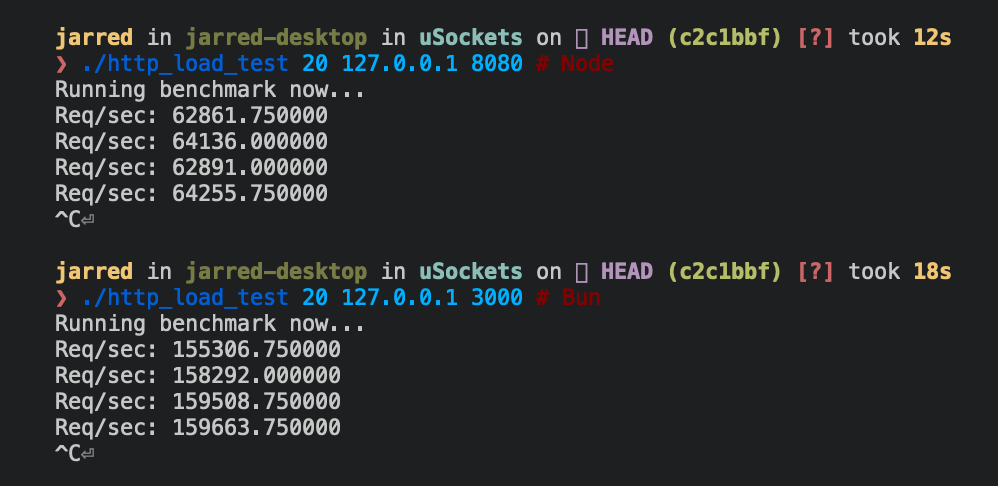
Below are Bun and Node.js implementations of a simple HTTP server that responds Bun! to each incoming Request.
{% codetabs %}
Bun.serve({
  fetch(req: Request) {
    return new Response(`Bun!`);
  },
  port: 3000,
});
require("http")
  .createServer((req, res) => res.end("Bun!"))
  .listen(8080);
{% /codetabs %}
The Bun.serve server can handle roughly 2.5x more requests per second than Node.js on Linux.
{% table %}
- Runtime
- Requests per second
- Node 16
- ~64,000
- Bun
- ~160,000
{% /table %}
{% image width="499" alt="image" src="https://user-images.githubusercontent.com/709451/162389032-fc302444-9d03-46be-ba87-c12bd8ce89a0.png" /%}
Reference
{% details summary="See TypeScript definitions" %}
interface Bun {
  serve(options: {
    fetch: (req: Request, server: Server) => Response | Promise<Response>;
    hostname?: string;
    port?: number;
    development?: boolean;
    error?: (error: Error) => Response | Promise<Response>;
    tls?: {
      key?:
        | string
        | TypedArray
        | BunFile
        | Array<string | TypedArray | BunFile>;
      cert?:
        | string
        | TypedArray
        | BunFile
        | Array<string | TypedArray | BunFile>;
      ca?: string | TypedArray | BunFile | Array<string | TypedArray | BunFile>;
      passphrase?: string;
      dhParamsFile?: string;
    };
    maxRequestBodySize?: number;
    lowMemoryMode?: boolean;
  }): Server;
}

interface Server {
  development: boolean;
  hostname: string;
  port: number;
  pendingRequests: number;
  stop(): void;
}
{% /details %}